NEWTON Blog
Companies House identity verification across multiple companies: one director, five deadlines
Karin Kuschel ·
Most Companies House ID verification deadlines follow each company’s own dates. How groups track directors and PSCs, before and after mid-November.
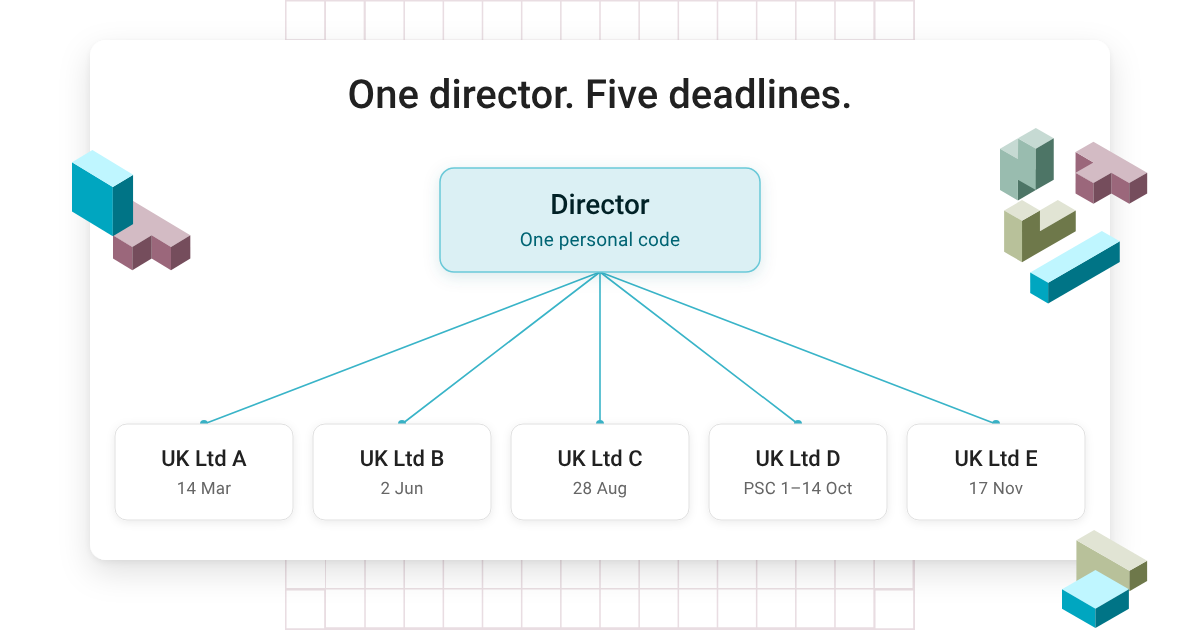
Imagine one of your directors sits on the boards of five UK companies. How many Companies House identity verification deadlines does she have? Not one. Five, at least.
Most of what you read about this online, focuses on mid-November 2026. That’s when the transition period ends. But if your company has multiple entities registered in the UK, that date has little or nothing to do with your deadlines.
The actual dates are defined by the entities’ confirmation statement. One for the parent, a different one for every individual PSC, and another one for overseas companies. And in September 2026, the first directors were convicted. One of them had verified himself.
Mid-November is not your deadline
Because if your directors were already in office, then your deadlines coincide with the company’s confirmation statement. According to Companies House, 18 November 2025 was the start of a 12-month transition, not a deadline. Each director must submit their personal code when the company files that statement.
A lot of deadlines have already passed. If one of your subsidiaries had to submit a confirmation statement in March, its directors’ codes were due in March too. Mid-November marks the backstop for the last companies who haven’t filed their confirmation statement yet.
PSCs (person with significant control) have their own deadline date: A 14-day window at the start of their birth month. And if you’re an overseas company with a UK establishment, there’s a third kind of date. All your directors have to be verified by the anniversary of the establishment’s registration.
What Companies House identity verification requires
Here’s the short version. Companies House identity verification is a one-off identity check that gives each person a personal code. That person then has to give the code separately for every director and PSC role they hold.
So there are two steps:
Verify once
You can do this online with GOV.UK One Login, and it’s free. Or you can use an Authorised Corporate Service Provider (ACSP), such as your accountant.
Link the code to every role
If you’re a director of several companies, you give the same code to each one. That usually happens with the company’s confirmation statement.
One thing gets mixed up a lot. What if someone is a director and a PSC of the same company? Then they give the code twice. First as a director, in the confirmation statement. Then as a PSC, within 14 days from the day after the confirmation statement date. Verifying as a director doesn’t cover the PSC role.
Why groups miss deadlines
It’s usually not because people refuse to verify themselves. It’s because the dates are scattered among entities and people, and nobody sees all of them together.
Every entity has its own date
A holding that includes five UK subsidiaries incorporated in different years has five confirmation statement deadlines. That’s five points where every director’s code has to be in place.
PSC windows follow birthdays, not the company calendar
A shareholder who isn’t on the board may just not be aware of this rule.
Overseas companies have their own anniversary
If your parent company is in DACH, Luxembourg or Singapore and has a UK establishment, that’s one more date to remember.
Non-UK directors need more lead time
Online verification works with a biometric passport from any country. Without one, they can’t use the bank or Post Office routes, because those are for UK residents only. So an ACSP is needed.
The information sits in different places
Your UK service provider files the confirmation statement. Your finance team at the parent holds the board list. Each director holds their own code.
What enforcement looks like so far
Enforcement has started. And it includes directors who verified themselves.
On 16 September 2026, the Insolvency Service won its first convictions for identity verification offences at City of London Magistrates’ Court. Three directors of two small companies were fined.
Two of them had continued to serve as directors and signed accounts without verifying. The third had verified. He was convicted anyway, because he didn’t take reasonable steps to stop his unverified co-director. All three were also convicted over late confirmation statements.
The fines were small, between £80 and £307 plus costs. But the fine isn’t the point. What matters is the criminal conviction. And the Insolvency Service was clear: as a director, you’re responsible for your own verification and for making sure unverified people don’t act for the company.
There’s still a lot more to do. By the end of June 2026, only 55% of director appointments and 42% of PSC appointments met the requirements, according to Companies House’s own figures. For a group, that means one verified director doesn’t make you compliant.
What to track for each UK entity
You need one overview per entity. These are the things that tell you who has to act, and when.
| What to track | Why it matters | Where the date comes from |
|---|---|---|
| Confirmation statement date | Directors’ codes are due with it | Companies House register |
| Directors and their status per company | The code is linked per appointment, not per person | Companies House register, per appointment |
| PSCs who aren’t directors | 14-day window at the start of their birth month | Companies House register shows the window |
| PSCs who are also directors | Second submission, 14 days after the confirmation statement date | Confirmation statement date |
| UK establishment of an overseas company | All directors verified by the registration anniversary | UK establishment registration date |
| Task owner | Someone has to chase each person and each date | Your own team |
What still applies after mid-November
The transition ends, but the work doesn’t. From now on, verification is part of every new appointment.
New directors
New directors will have to verify before they start acting. That’s been the rule since 18 November 2025.
New PSCs
Newly added PSCs disclose their code when they’re added to the register, or within 14 days.
People who file documents
People who file documents will have to verify too, but not before November 2027. Companies House will give at least six months’ notice. Agents who file for a company are required to register as an ACSP.
Corporate directors, officers of corporate PSCs and limited partnerships
Corporate directors, officers of corporate PSCs and limited partnerships come later. There’s no date yet.
So for a business, this isn’t a one-off project. It’s a step you repeat every time you appoint a director, change a shareholder or restructure.
Where NEWTON fits
Before it becomes a compliance issue, it’s a data problem. The dates are all out there. They’re just not in one place.
In NEWTON, you keep directors and shareholders on record for each entity, right next to registration numbers and documents. You add confirmation statement dates, PSC windows and anniversaries as compliance tasks. Each task gets a due date, an owner and automated reminders. One list shows every task across every entity, and you can filter it by entity, type or status. Reports export the overview to Excel for your board or your auditor.
To be clear: NEWTON doesn’t verify identities, and it doesn’t file with Companies House. It gives your finance and operations team the overview, so the right people act on time.
See how compliance tracking works across your entities. Start a 14-day free trial. No credit card needed.
Frequently asked questions
No. You verify once and receive one Companies House personal code. You then provide that code to each company separately, usually with each company’s next confirmation statement.
A PSC who isn’t a director of the company provides it within the first 14 days of their birth month. A PSC who is also a director provides it again as PSC, within 14 days starting the day after the confirmation statement date. Anyone who became a PSC after 18 November 2025 provides it when added to the register or within 14 days.
It’s a criminal offence. The first convictions in September 2026 led to fines, and one of the directors convicted had verified himself but failed to stop an unverified co-director from acting. The company’s confirmation statement can also end up late.
Yes, if they have a biometric passport from any country. Directors without one can verify through an Authorised Corporate Service Provider, such as an accountant. Plan extra lead time for this route.
No. NEWTON keeps director and shareholder records per entity and tracks verification dates as compliance tasks with owners and reminders. The verification itself happens through Companies House or an ACSP.
Sources
All sources are free to access.
| Source | Publisher | Date |
|---|---|---|
| Directors warned to verify identities with Companies House following first Insolvency Service prosecutions | Insolvency Service and Companies House, GOV.UK | 17 Sep 2026 |
| When you need to verify your identity for Companies House | Companies House, GOV.UK | Updated 30 Jul 2026 |
| Verify your identity for Companies House | Companies House, GOV.UK | Updated 30 Apr 2026 |
| ECCTA outline transition plan for Companies House | Companies House, GOV.UK | Updated 5 Aug 2026 |
| Companies House management information: identity verification April to June 2026 | Companies House, GOV.UK | 30 Jul 2026 |